


Moling vs Traditional Excavation Methods: Which Suits Your Property?

Choosing between moling vs traditional excavation methods comes down to one question: how much ground are you willing to disturb to reach a buried water pipe? Moling pushes a steel or pneumatic mole through the soil from a small launch pit, leaving lawns, driveways and patios largely untouched.
This guide from External Moling Services Ltd draws on more than 20 years of trenchless water pipe work across London and Southeast England, where Victorian terraces, mature gardens and tight access roads make digging a trench an expensive last resort.
Key TakeawayMoling suits most domestic water supply pipe replacements. Open-cut excavation remains the better choice for shallow pipes, rocky ground and routes that need continuous inspection.
How Impact Moling and Open-Cut Excavation Actually Differ
Impact moling and open-cut excavation differ in how they create a path for a new pipe: moling displaces soil sideways as a mole travels underground, while open-cut excavation removes soil entirely along the route. That distinction explains almost every practical difference between the two.
What Happens During a Moling Job
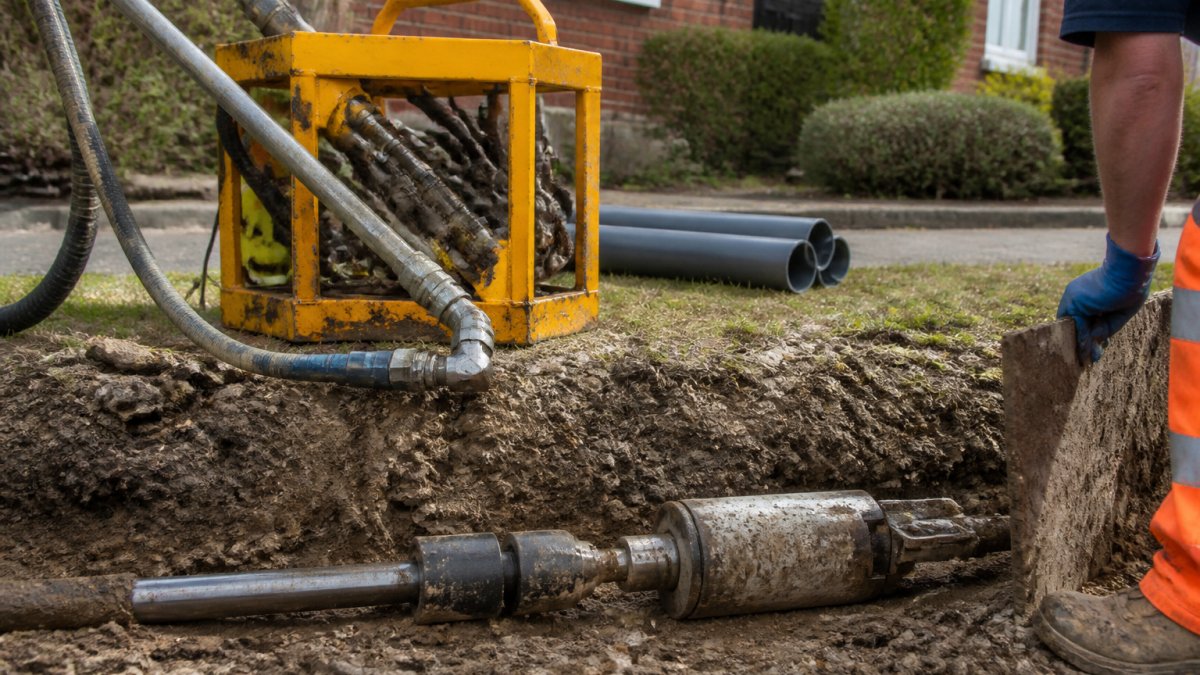
A moling crew digs a small entry pit, usually around one square metre, and sometimes a matching exit pit where the new pipe connects. A pneumatic mole is launched from the entry pit, travels through the soil along a controlled path, and pulls the new MDPE water pipe behind it. The ground is displaced rather than removed, so there is minimal spoil and the surface above stays intact.
What Happens During Open-Cut Excavation
Open-cut excavation means digging a continuous trench from the water main to the property, typically 750mm to 1,350mm deep depending on local conditions, then backfilling and reinstating the surface. It gives engineers full visibility of the pipe run, which matters on complex routes, but means excavating every lawn, path and driveway along the way.
The Benefits of Impact Moling for Water Supply Pipes
The benefits of impact moling come down to three things: speed, surface preservation and cost. Because the mole travels underground, the excavation footprint shrinks from a full trench to a couple of small pits. A typical domestic moling job finishes in a day, while open-cut work on the same route often runs to several days once digging, backfilling and reinstatement are counted.
For homeowners, the practical wins are obvious:
Landscape preservation - lawns, borders, block paving and resin driveways stay untouched
Minimal disruption - no skips, no spoil heaps, no site compound on your front garden
Noise reduction and dust mitigation - far less plant machinery running all day
Speed of installation - most domestic runs finish within a single working day
Ground stability - the soil around the pipe is displaced and compacted rather than left loose
This is why moling has become the default choice for water pipe replacement on established residential streets: digging up a shared driveway or a neighbour's boundary is rarely popular and can drag in permissions you would rather avoid.
Trenchless Water Pipe Replacement Cost: What Drives the Price
Trenchless water pipe replacement cost is driven by four variables: run length, ground conditions, pipe diameter, and the reinstatement burden.
Run length. Moling is priced largely per linear metre, but the rate is not flat.
Ground conditions. Soft clay and firm loam are the mole's natural habitat, the soil compresses cleanly and the mole tracks true.
Pipe diameter. Domestic supply pipes are almost always 25mm or 32mm MDPE.
Reinstatement. This is the cost driver most homeowners underestimate.
Cost FactorMolingOpen-Cut ExcavationExcavation footprintSmall entry and exit pits (often ~1m² each)Continuous trench along the full routeSpoil removalMinimal, soil is displaced, not removedSignificant, skips and cart-away requiredReinstatementRarely needed beyond pit capsOften extensive: paving, turf, sub-baseTypical durationOften one working daySeveral days including backfill and reinstatementAccess requirementsTight spaces and shared driveways possibleNeeds open access for plant and spoilCost sensitivity to groundHigh, poor ground can force recovery workLower, the trench is dug regardlessCost sensitivity to surfaceLow, surface stays intactHigh, reinstatement scales with surface value
Two practical points follow.
We price every job individually because no two routes are the same. For a current figure, request a free quote and we will survey the run and give you a fixed price with no hidden extras.
Pro TipAsk any contractor to state, in writing, what happens to the price if the ground turns out to be harder than the survey suggested. A fixed price with a defined recovery clause is worth more than a low estimate with an open-ended caveat.
Water Pipe Replacement Regulations UK: What You Need to Know
Water pipe replacement regulations UK homeowners should know about centre on the water fittings rules and the notification requirements that apply when you replace or alter a supply pipe. In practice, any new or replacement underground water supply pipe must be installed to the standards set out in the Water Supply (Water Fittings) Regulations, and your water company needs to be told before the work starts so it can inspect and, where required, approve the connection.
Two practical points catch people out:
Notification before work begins.Most water companies require advance notice of a supply pipe replacement. Turning up and digging without notifying them can delay the reconnection.
Approved materials only. The new pipe must be a compliant material, typically MDPE, installed to the correct depth and protected where it passes through foundations.
As an approved water board company, External Moling Services Ltd handles the notification and inspection process as part of the job, so you are not left chasing paperwork while your water is off.
Soil Suitability and Depth Control: Where Moling Reaches Its Limits
Moling does not work in every ground condition, and any provider who claims otherwise is overselling. The method relies on the soil compressing around the mole as it passes. Where the ground cannot compress cleanly, the borehole collapses, the mole drifts off line, or the pull force exceeds what the rig can deliver. Knowing which side of that line your ground sits on is the most useful thing to establish before committing to a method.
A Feasibility Checklist for Moling
Moling is viable when the answers below are favourable. If two or more are unfavourable, open-cut excavation or directional drilling is usually more reliable.
Soil type. Firm clay, stiff silt and cohesive loam are ideal. Loose sand, gravel, made ground, rubble and peat are poor, the bore will not hold.
Water table. A high or fluctuating water table is a warning sign. Waterlogged ground lubricates the mole poorly and the bore can slump behind it.
Obstructions. Buried foundations, old walls, tree roots and previous service trenches all deflect the mole. A route survey should map these before launch.
Depth consistency. Moling suits runs at a broadly constant depth, generally between around 750mm and 1,350mm. Sharp rises or falls tighten the tolerance and raise the risk of striking an existing service.
Proximity to other services. Gas, electricity, telecoms and drainage lines within a metre of the route require a careful survey and, often, a hand-dug pilot.
Run length and curvature. Long, straight runs are straightforward. Tight bends are not, the mole cannot steer like a directional drill.
Access for the rig. A launch pit needs a clear approach for the rig and, on some sites, a water supply for lubrication.
Depth Control and Tolerance
Depth control is the other limitation. The mole travels in a roughly straight line from the launch pit, so the entry angle determines the exit depth. Where the pipe must rise or fall sharply, or pass close to other buried services, tolerance tightens and the risk of striking a utility line rises. That is why a route survey and buried-services check are not optional extras, they are the difference between a clean pull and a damaged gas line.
When Moling Is Not the Right Fit
Where the checklist fails, the honest answer is to change method rather than force the mole. The usual alternatives are:
Open-cut excavation, the reliable fallback for rocky, loose or shallow ground, and for routes needing continuous inspection.
Directional drilling, steerable, so it can follow a curved path and cope with some obstructions that defeat a mole, though it needs more set-up and a larger rig.
Hand-dig and relay, for very short runs where the surface is being replaced anyway.
We survey the route first and tell you honestly if moling is not the right fit. That conversation is cheaper than a failed pull.
Watch OutNever let a contractor start moling without a route survey and a check for existing buried services. Hitting a gas or electricity line underground is dangerous and expensive, and it is entirely avoidable with a proper survey.
Long-Term Maintenance and Site Restoration Compared
Long-term, the two methods leave you with a similar pipe but a very different property. A moled installation leaves the surface above essentially as it was, so there is nothing to settle, crack or re-plant. Open-cut excavation leaves a reinstated strip that can settle over time, particularly where backfill was not compacted properly, and paving or turf rarely matches the original perfectly.
On maintenance, a new MDPE pipe behaves the same whether moled or trenched. The difference is access: a moled route can usually be re-entered through the same small pits, while a trenched route may mean digging the strip up again.
Choosing Between Moling and Traditional Excavation Methods
For most residential water supply pipe jobs, moling wins on disruption, speed and total cost once reinstatement is counted. Open-cut excavation still has a place: rocky or loose ground, very shallow pipes, complex routes needing continuous inspection, or runs where the surface is already being replaced.
Here is how we would decide:
Choose moling for established gardens, driveways, patios, tight access and older properties with lead pipework
Choose open-cut for shallow runs, unstable ground, or where the surface is being dug up regardless
Ask for a survey first - the right method follows the ground, not the other way round
That is the honest answer to moling vs traditional excavation methods: there is no single winner, only the right method for your specific route and ground.
Replacing a leaking or lead water pipe is stressful enough without a contractor turning your garden into a building site. External Moling Services Ltd has spent over 20 years solving exactly this problem across London and Southeast England, as an approved water board company with fully qualified engineers and a 10-year labour guarantee on water main replacements and repairs.
Frequently Asked Questions
Is moling suitable for all soil types?
No. Impact moling works best in firm, cohesive soils such as clay, which is common across London and the South East. Loose sand, gravel, or ground filled with rubble and old foundations can cause the bore to deviate or collapse, and solid rock is a barrier entirely. A site survey before any work starts establishes whether the ground can take a mole or whether open-cut excavation or directional drilling is the safer route.
Does moling require planning permission or building regulations approval?
Moling itself does not normally need planning permission because it creates no permanent above-ground structure. However, work on a water supply pipe still has to meet the Water Supply (Water Fittings) Regulations 1999, and any new or replacement underground supply pipe must be notified to the local water authority before it is connected. Approved contractors handle that notification as part of the job.
How much does moling cost compared with traditional excavation?
Pricing depends on pipe diameter, run length, ground conditions, and access, so no two jobs are quoted the same. Moling usually avoids the costs that push open-cut work up: reinstating driveways, patios, and lawns, plus the labour of removing and returning spoil. Get a written, itemised quote that confirms what is included and whether any ground conditions could trigger extra charges.
How long does a moling installation take compared with digging a trench?
A typical domestic moling run can be completed in a day, with water restored the same day in most cases. Open-cut excavation over the same distance often runs to several days once you count digging, laying the pipe, backfilling, compacting, and surface reinstatement. The gap widens on longer runs and on properties where the trench would cross hard landscaping.


Comments